
Sub-Total: $0.00
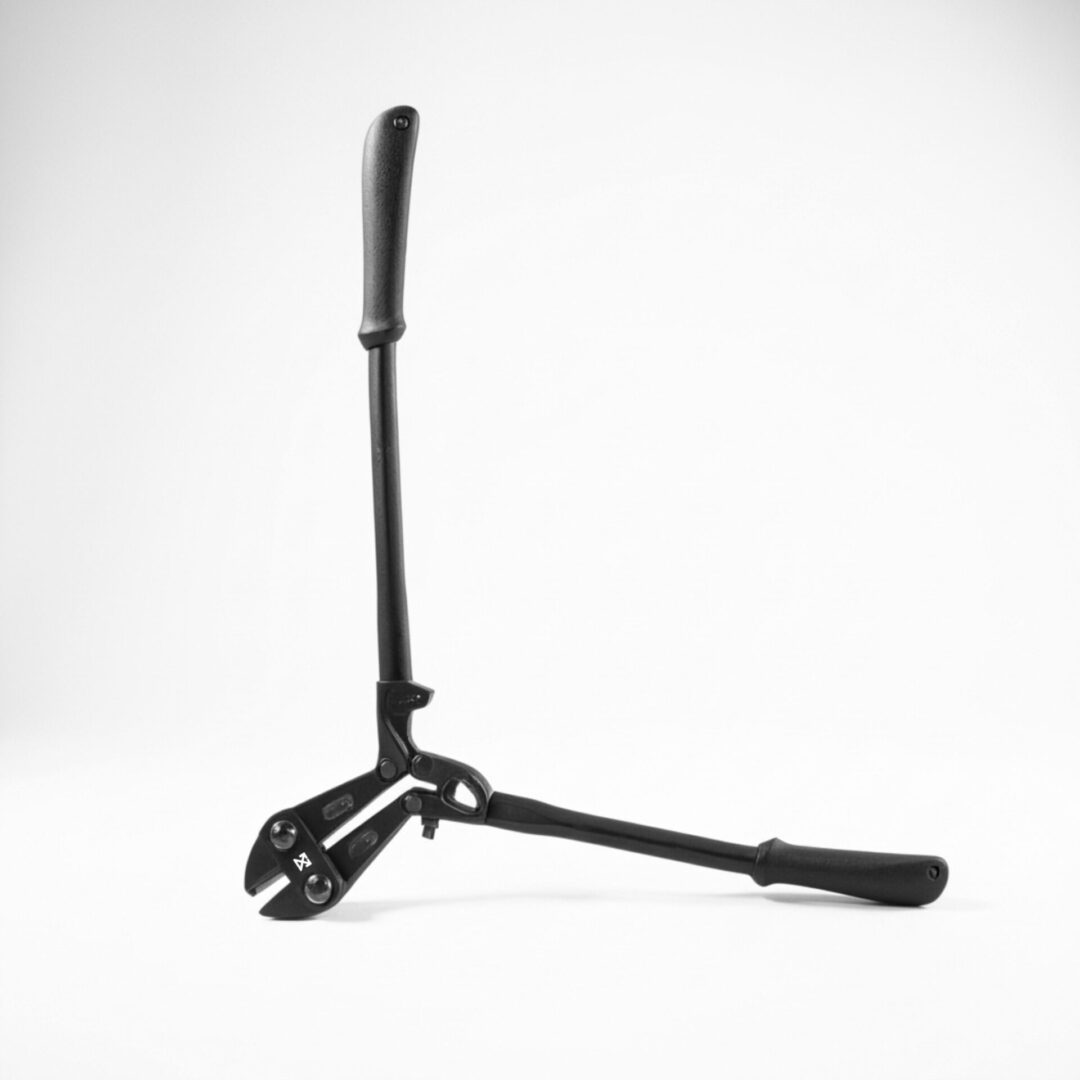
Bolt Cutter Guide
Choosing the Right Bolt Cutters for Tactical and Law Enforcement Operations
Table of Contents
- Introduction
- Define the Mission Before Selecting the Tool
- Cutting Capacity vs Real-World Materials
- Blade Design and Metallurgy
- Handle Length, Leverage, and Ergonomics
- Noise, Speed, and Control
- Durability and Maintenance Considerations
- Manual vs Assisted Cutting Tools (Contextual Consideration)
- Proper Bolt Cutter Technique and Material Failure Mechanics
- Training and Integration Into Breaching Doctrine
- Conclusion
1. Introduction
Bolt cutters are often treated as basic tools—select a size, cut the lock, and move on. In real-world law enforcement and tactical operations, however, bolt cutters function as force-application tools whose effectiveness depends on leverage, blade metallurgy, operator mechanics, and the material being defeated. These factors become evident when working against common field targets such as the Master Lock M1XD laminated steel padlock, a widely available lock frequently encountered on sheds, gates, storage units, and utility enclosures.
Although not classified as a high-security lock, the M1XD’s 5/16-inch boron-carbide shackle and laminated steel body are designed to resist casual cutting attempts. In training and operational settings, this type of lock routinely exposes limitations in under-specified bolt cutters, worn blades, or poor technique. It represents a realistic benchmark for evaluating whether a cutter is appropriate for typical law enforcement use rather than theoretical maximums.
This guide outlines how law enforcement and tactical teams should evaluate bolt cutters based on observed field performance, mechanical principles, and practical training considerations—not solely on manufacturer specifications.
2. Define the Mission Before Selecting the Tool
Operational requirements should drive tool selection. The most common procurement mistake is choosing bolt cutters based primarily on advertised cutting capacity without considering how and where the tool will be used.
Before selecting a cutter, teams should assess:
- The barriers most frequently encountered, such as padlocks, chain, fencing, cable, or rebar
- The operational environment, including warrant service, emergency response, perimeter access, or corrections work
- Whether the tool is carried by a designated breacher or shared across personnel
- The balance between speed, discretion, and repeatability
A bolt cutter that performs adequately on mild steel fencing may perform inconsistently or fail when applied to hardened shackles or higher-quality chain.
3. Cutting Capacity vs Real-World Materials
Cutting capacity is often communicated in terms of diameter, but diameter alone does not predict performance. Material hardness is frequently the limiting factor.
When evaluating capacity, consider:
- Whether stated ratings apply to mild steel or hardened materials
- The hardness characteristics of commonly encountered locks and chain
- Blade geometry and its ability to maintain engagement under load
In practice, smaller-diameter hardened shackles may require more force to defeat than thicker mild steel materials. Diameter ratings without material context should be interpreted cautiously.
If your team is evaluating or standardizing bolt cutters, Breach Pro can help assess real-world options based on common field targets and operational use. Learn more about our bolt cutters or speak with our team to discuss fit for your mission.
4. Blade Design and Metallurgy
Blade construction is a primary determinant of reliability and safety.
Key characteristics include:
- Heat-treated tool steel capable of maintaining edge integrity under high load
- Blade profiles that maintain alignment and reduce material slippage
- Replaceable blades to support long-term serviceability
- Predictable overload behavior, where deformation occurs before fracture
Blade failures in operational settings create safety hazards and undermine confidence in the tool. Proven metallurgy and controlled failure modes are therefore essential.
5. Handle Length, Leverage, and Ergonomics
Handle length influences both mechanical advantage and practical deployment. Longer handles increase leverage but may be impractical in confined spaces, while shorter cutters trade leverage for maneuverability.
Evaluation factors include:
- Available space at likely breach points
- Grip design and traction when used with gloves or in adverse conditions
- Tool balance during one-person operation
- Operator fatigue during repeated use
Effective bolt cutters are those that can be deployed quickly, aligned correctly, and driven through the cut without excessive repositioning.
6. Noise, Speed, and Control
Bolt cutters are often selected for their relatively low noise signature. However, inconsistent blade engagement or insufficient force can result in repeated attempts, increasing both noise and exposure time.
Operational efficiency favors tools that produce consistent, single-cycle cuts. Predictability and control are generally more valuable than marginal gains in cutting speed.
7. Durability and Maintenance Considerations
Bolt cutters are routinely subjected to overload, impact, and environmental exposure. Durability should be evaluated based on realistic use rather than ideal conditions.
Relevant considerations include:
- Pivot strength and tolerance retention under load
- Blade serviceability and ease of replacement
- Corrosion resistance for outdoor or maritime use
- Documented performance in training or operational settings
Tools with higher upfront cost but longer service life and maintainability often provide lower total cost of ownership.
8. Manual vs Assisted Cutting Tools (Contextual Consideration)
While this article focuses on traditional manual bolt cutters, assisted cutting tools are sometimes employed in specialized roles. These systems can reduce physical strain and expand cutting capability but introduce additional weight, complexity, and logistical requirements.
For many agencies, manual bolt cutters remain the most practical and frequently deployed option due to their simplicity, reliability, and ease of training integration.
9. Proper Bolt Cutter Technique and Material Failure Mechanics
Tool selection alone does not determine cutting success. Operator technique is a critical performance variable.
A commonly taught and operationally effective method involves anchoring one handle of the bolt cutter against the hip or upper thigh while applying force with both hands on the opposite handle.
Proper technique includes:
- A stable, staggered stance
- One handle fixed firmly against the body to create a reaction point
- Both hands on the driving handle
- Force generated through the legs and core rather than the arms alone
This method increases effective input force, improves alignment, and reduces fatigue—particularly when defeating hardened shackles.
Bolt cutters do not cut material in the traditional sense. Instead, they apply extremely high compressive force at a small contact area between the jaws. When this localized stress exceeds the shear strength of the material, failure occurs through shear fracture rather than slicing.
This explains why certain common padlocks defeat poorly designed or worn cutters despite appearing within nominal capacity ratings.
10. Training and Integration Into Breaching Doctrine
Bolt cutters should be integrated into a broader breaching framework rather than treated as standalone solutions.
Effective integration includes:
- Training to identify appropriate and inappropriate cutting targets
- Standardized blade placement and body mechanics
- Clear decision points for transitioning to alternate methods
- Reinforcement of safety considerations during tool failure or slippage
Proper training ensures bolt cutters enhance operational capability rather than introduce delays or unnecessary risk.
11. Conclusion
Selecting bolt cutters for law enforcement and tactical use requires more than comparing size or advertised capacity. It involves understanding material behavior, tool mechanics, operator technique, and realistic mission requirements.
When selected appropriately and used correctly, bolt cutters provide reliable, controlled access through common barriers. When selected or employed without sufficient consideration, they can slow entry, increase exposure, and compromise safety.
____________________________________________________________________________________
If you are responsible for procurement, training, or operational readiness and would like to discuss bolt cutter selection or integration into a broader breaching program, the Breach Pro team is available to help. Browse our breaching tools or contact us to start a practical, experience-driven conversation focused on your mission—not a catalog.