
Sub-Total: $0.00

How to Choose a Patrol Breaching Kit
A patrol breaching kit gets bought once and used under the worst conditions imaginable. A barricaded door. A welfare check that turns into an active threat. An officer alone, already carrying a rifle, a shield, a med kit, and a duty belt loaded with everything else the job demands, now needing to get through a door in seconds. If the kit sitting in the trunk was chosen on price alone, or copied from a SWAT loadout that was never built for this job, that is the moment it fails.
Sergeants and command staff building out patrol level breaching capability are usually solving a problem nobody trained them for. Here is how to think through it.
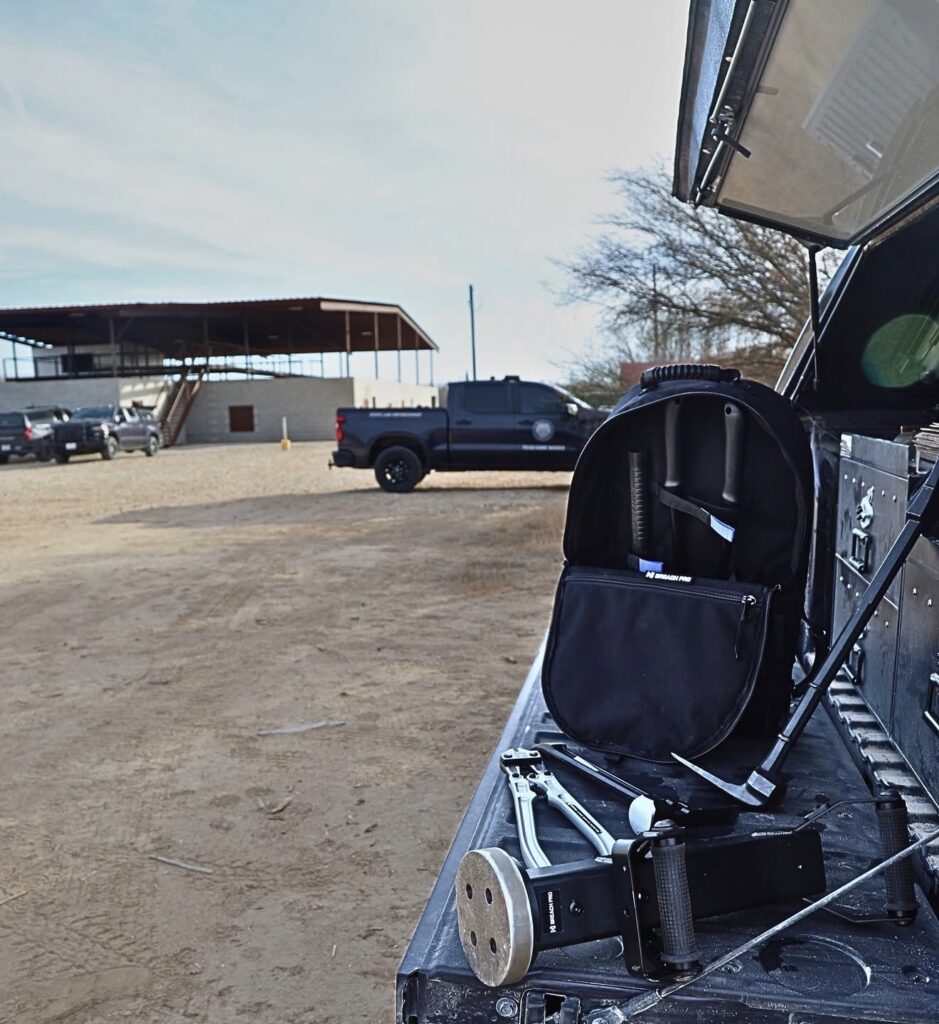
Duffle vs. Backpack: Cost vs. Utility
The bag decision is not cosmetic. It determines how fast the kit deploys and what it costs to outfit a fleet.
A duffle bag is the lower cost option and it is genuinely a reasonable choice for a kit that lives in a trunk or a rack and gets pulled out, unzipped, and used from the ground. It holds more, it is cheaper to buy in volume across a department, and it does not ask anything of the officer’s body while it sits in the vehicle.
A backpack costs more per unit but changes what the kit can do. It frees both hands during the approach, distributes weight across the frame instead of one shoulder, and lets an officer move to a door, cover ground, or work with a partner without setting a bag down first. That utility matters most when the kit needs to move with the officer, not just ride to the scene.
The honest answer for most departments: duffle for kits that stay vehicle side and get walked in a short distance, backpack for kits assigned to officers who may need to move with the tools before they ever reach the door. Budget for both if the fleet mix demands it, rather than defaulting to whichever is cheaper for every vehicle.
Tool Selection: What Actually Belongs in the Kit
Halligan. Length is a leverage question before it is a portability question. A short halligan is easier to stow but gives up mechanical advantage exactly when it is needed most, on a commercial steel door with a security strike plate instead of a residential jamb. If there is any chance the kit faces commercial doors, buy the length that gives the operator leverage to win that fight, not the length that fits neatest in the bag. For pure residential work, a shorter tool trades some leverage for speed and stowability. [We cover halligan geometry, spike vs. no-spike, and adze selection in detail in our halligan buyer’s guide.]
Sledge. A 6 lb head on a fiberglass handle is the right default for a patrol kit. Fiberglass absorbs shock better than wood or steel over repeated strikes, holds up to inconsistent maintenance and vehicle storage, and the 6 lb head hits the point where an officer generates real striking force without the kit becoming something only the strongest person on shift can swing effectively.
Bolt cutters. Handle length has to be sized to the lock, not just the cost sheet. Hardened padlocks with boron-carbide shackles, the kind showing up in newer Master Lock designs, are built specifically to resist casual cutting. Under-length bolt cutters will not generate the leverage to defeat that shackle, and an officer finding that out mid-call is a training and safety failure, not a minor inconvenience. [Our bolt cutter guide walks through blade metallurgy and leverage in more depth if you want to go further on this.]
Weight vs. Everything Else the Officer Is Already Carrying
None of this gets chosen in a vacuum. The officer reaching for this kit is already wearing a duty belt loaded with a firearm, magazines, less-lethal, cuffs, and a radio. Many are carrying a rifle. Some are staged with a med kit. And the call that puts a breaching kit in an officer’s hands is frequently an active threat response, where every second and every pound of added fatigue matters.
That context should drive tool weight decisions more than a spec sheet does. A heavier halligan or a bigger bolt cutter might look more capable on paper, but if it is the tool that slows an already overloaded officer down at the door, it is the wrong tool for this role. The goal is the lightest combination of halligan, sledge, and bolt cutters that can still reliably defeat the doors that department actually encounters, not the most capable combination that exists.
How the Tools Get Used, and How They Get Stowed
Patrol breaching tools live two lives: staged in the vehicle, and in hand at the door. Kit selection needs to account for both.
Stowage is usually a trunk mount, a rack, or the duffle/backpack itself living in a fixed spot in the vehicle. The kit needs to survive that environment: temperature swings, vibration, and long stretches with no inspection between calls.
Deployment looks different depending on the department. Some patrol officers work solo and need a kit they can retrieve and carry to a door without assistance. Others regularly stage alongside a ballistic shield, where the breacher is working one-handed or coordinating tool handoffs with the shield operator. If shield pairing is a real scenario for your department, factor that into bag choice and tool length; a kit built only around solo, two-handed use may not translate cleanly to shield work.
Officer Capability Varies. Plan for That, Not Around a Single Officer.
Every department has a range of strength, fitness, and experience across its patrol shift. A kit that assumes every officer can comfortably swing an 8 lb sledge or manage a 30-inch halligan one-handed is a kit built for the strongest officer on the roster, not the shift as a whole.
This is not an argument for the lightest possible gear across the board. It is an argument for command staff to actually think through their own department’s range of capability before locking in a kit, rather than defaulting to whatever a SWAT team down the road is carrying. The right questions are internal: What is the realistic range of strength and experience on this shift? Does the kit need to work for a solo officer at 2am, or will backup typically be close? Those answers, not a spec sheet, should decide the final loadout.
The Bottom Line
A patrol breaching kit earns its place in the vehicle when it matches the doors the department actually faces, the weight the officer is already carrying, and the range of people who will reach for it under stress. Get the bag, the tool lengths, and the weight right for your department’s actual calls, and the kit becomes something officers trust instead of something that rides in the trunk untouched.
Breach Pro designs and manufactures mechanical breaching tools and training systems for law enforcement, military, and government customers. Building solutions that operators trust in the most critical moments.